 By Admin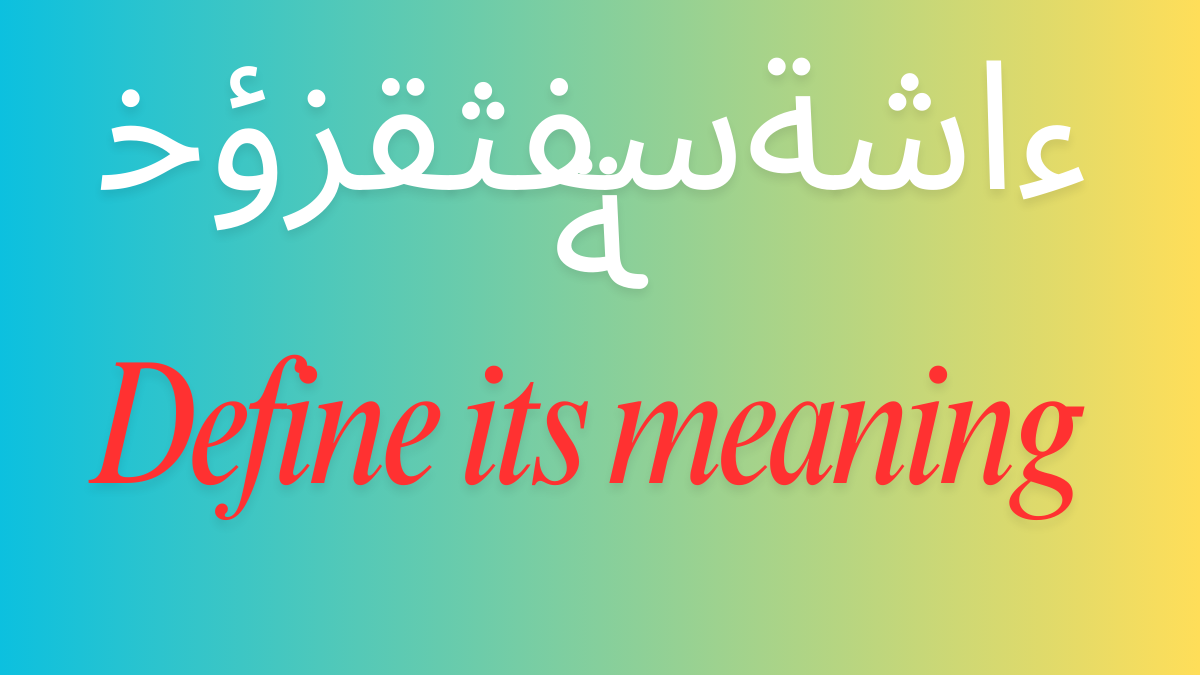
Every language has its mysteries, from forgotten dialects to strange inscriptions carved on old walls. But sometimes, a sequence of letters appears that has no dictionary entry, no cultural reference, and no hidden code behind it. One example is the string “ءاشةسفثقزؤخة.” To someone who doesn’t read Arabic, it might look like a meaningful word. Even native speakers may pause for a moment, wondering whether it belongs to a rare dialect or a specialized field.
In reality, this string doesn’t form a meaningful Arabic word. Still, its structure gives us a chance to explore how Arabic script works, why such random combinations frequently appear online, and how people interpret unfamiliar text in the digital age.
Understanding Why “ءاشةسفثقزؤخة” Has No Meaning
Arabic is built on structured root patterns. Real words almost always follow forms based on three-letter roots, which create predictable patterns for nouns, verbs, adjectives, and expressions. When you look at “ءاشةسفثقزؤخة,” it doesn’t follow any recognized linguistic pattern. It contains:
- a hamza at the start, which rarely begins full standalone words in this shape
- letters placed together in a sequence that doesn’t align with standard Arabic phonetic flow
- no identifiable root or morphological pattern
To a native reader, the sequence immediately registers as random. It doesn’t sound like a word, and it doesn’t resemble anything used in classical or modern Arabic.
Why Random Arabic Text Appears Online
Although this string has no meaning, random Arabic strings often show up in several contexts:
1. Keyboard Mash
People sometimes hit random keys on an Arabic keyboard, either intentionally or by accident. Because the layout is different from English, the result looks foreign and mysterious to someone unfamiliar with it.
2. Testing Fonts or Software
Developers and designers often use random Arabic text to test typography, alignment, or interface behavior. Tools like “Lorem Ipsum” don’t always include Arabic script, so random sequences fill the gap.
3. Creative or Cryptic Styling
Some users like posting unusual letter combinations to give an air of mystery. In online communities, strange scripts are sometimes used for aesthetic effect, much like stylized symbols or glitchy text.
4. Mistyped Searching
People who are new to the Arabic keyboard sometimes type unfamiliar combinations while trying to learn where each letter is placed.
In every case, the intention isn’t to form a word but to produce letters that visually belong to Arabic script.
How Readers Interpret Unfamiliar Arabic Text
Even without meaning, strings like “ءاشةسفثقزؤخة” spark curiosity. Humans naturally try to assign patterns and significance, especially when a script looks foreign. Some common reactions include:
Trying to pronounce it
Someone might try sounding it out, only to discover that the letter order doesn’t feel natural or pronounceable.
Assuming it’s a name
Because many names in Arabic are unique or regional, outsiders sometimes assume any unusual string might be one.
Thinking it’s a cipher
In the digital age, mysterious text often makes people think of encrypted messages or hidden codes.
Searching for translation
People may believe it’s slang, a rare dialect, or an inside reference.
This desire to decode text says a lot about how people interact with unfamiliar languages online.
Could “ءاشةسفثقزؤخة” Be Given Meaning?
While the string is meaningless in its current form, it can be used creatively:
As a fictional word
Writers sometimes invent words that sound foreign or ancient. This could serve as a name for a mythical place, a spell, an artifact, or a character.
As a symbolic concept
Someone might use it as a metaphor representing confusion, mystery, or randomness.
As an aesthetic element
In design projects, the visual flow of Arabic letters can be used decoratively. Even unreadable text can create a stylistic effect.
Invented words are common in fantasy worlds, brand names, and artistic works. So while it lacks linguistic legitimacy, it has creative potential.
What the String Reveals About Digital Communication
“ءاشةسفثقزؤخة” may not mean anything, but it highlights several aspects of modern communication:
1. Scripts influence perception
Non-Arabic readers tend to assume meaning where none exists, simply because the script looks structured and ancient.
2. Technology makes randomness visible
Auto-suggest, touchscreen slips, and keyboard experiments all create strings that wouldn’t appear in classical writing.
3. Curiosity drives engagement
A meaningless sequence can still start a conversation, spark a question, or inspire an article like this one.
4. Linguistic literacy shapes interpretation
Someone familiar with Arabic dismisses it instantly, while someone who doesn’t know the script sees mystery instead of nonsense.
The digital world blends cultures quickly, and unfamiliar scripts often carry more intrigue than they deserve.
Conclusion
The string “ءاشةسفثقزؤخة” doesn’t have a meaning in Arabic. It isn’t a word, name, phrase, or coded message. Instead, it’s an accidental or intentional cluster of letters with no linguistic structure behind it. Even so, its mystery invites curiosity, and its form offers a chance to explore how we interpret language, how randomness appears online, and why unfamiliar text often feels meaningful even when it isn’t.